

Why Researchers Use Peptide Stacks in Laboratory Studies
Peptide research often focuses on understanding how individual signaling molecules interact with specific biological pathways. However, many biological systems operate through complex networks rather than isolated mechanisms. For this reason, researchers frequently investigate combinations of peptides that influence multiple signaling pathways simultaneously.
These multi-peptide combinations—often referred to as peptide stacks—allow scientists to examine coordinated biological responses across interconnected systems such as cellular repair, metabolic regulation, neurochemical signaling, and inflammatory response pathways.
Rather than studying a single signaling mechanism in isolation, peptide stacks can provide a broader view of how biological processes interact within controlled experimental environments.
Understanding Multi-Pathway Signaling
Biological systems rarely rely on a single molecular signal to regulate complex processes. Tissue repair, immune response, and metabolic regulation often involve multiple signaling pathways working together.
For example, cellular repair processes may involve:
Extracellular-matrix remodeling
Angiogenesis and vascular signaling
Cellular migration and proliferation
Inflammatory response modulation
Each of these processes can be influenced by different signaling molecules. Studying them together allows researchers to better observe how these mechanisms interact within biological systems.
Peptide stacks provide a structured way to examine these multi-pathway relationships.
Advantages of Multi-Peptide Research Models
When researchers design experiments that involve multiple biological mechanisms, peptide stacks can simplify experimental protocols.
Some potential advantages include:
Coordinated Signaling Research
Stacks allow scientists to observe how multiple signaling pathways respond together within the same experimental model.
Reduced Experimental Variability
Using a predefined peptide combination helps maintain consistency across experiments and simplifies preparation protocols.
Broader Biological Insight
Because many physiological processes are interconnected, multi-peptide systems may provide a more complete understanding of complex biological behavior.
Common Areas of Stack-Based Research
Peptide stacks are often explored in laboratory research involving several key biological systems.
Tissue Repair and Structural Signaling
Some peptides studied in stacks are associated with cellular repair mechanisms, extracellular-matrix remodeling, and vascular development pathways.
Metabolic and Mitochondrial Function
Other peptide combinations are examined in models studying energy metabolism, mitochondrial signaling, and cellular energy regulation.
Neurochemical and Cognitive Signaling
Certain peptides interact with neurotransmitter systems and are investigated in research related to neural communication and stress-response pathways.
Longevity and Cellular Maintenance
Some stacks combine peptides associated with cellular maintenance pathways and oxidative stress regulation, helping researchers examine mechanisms related to cellular resilience.
Why Consistency Matters in Stack Research
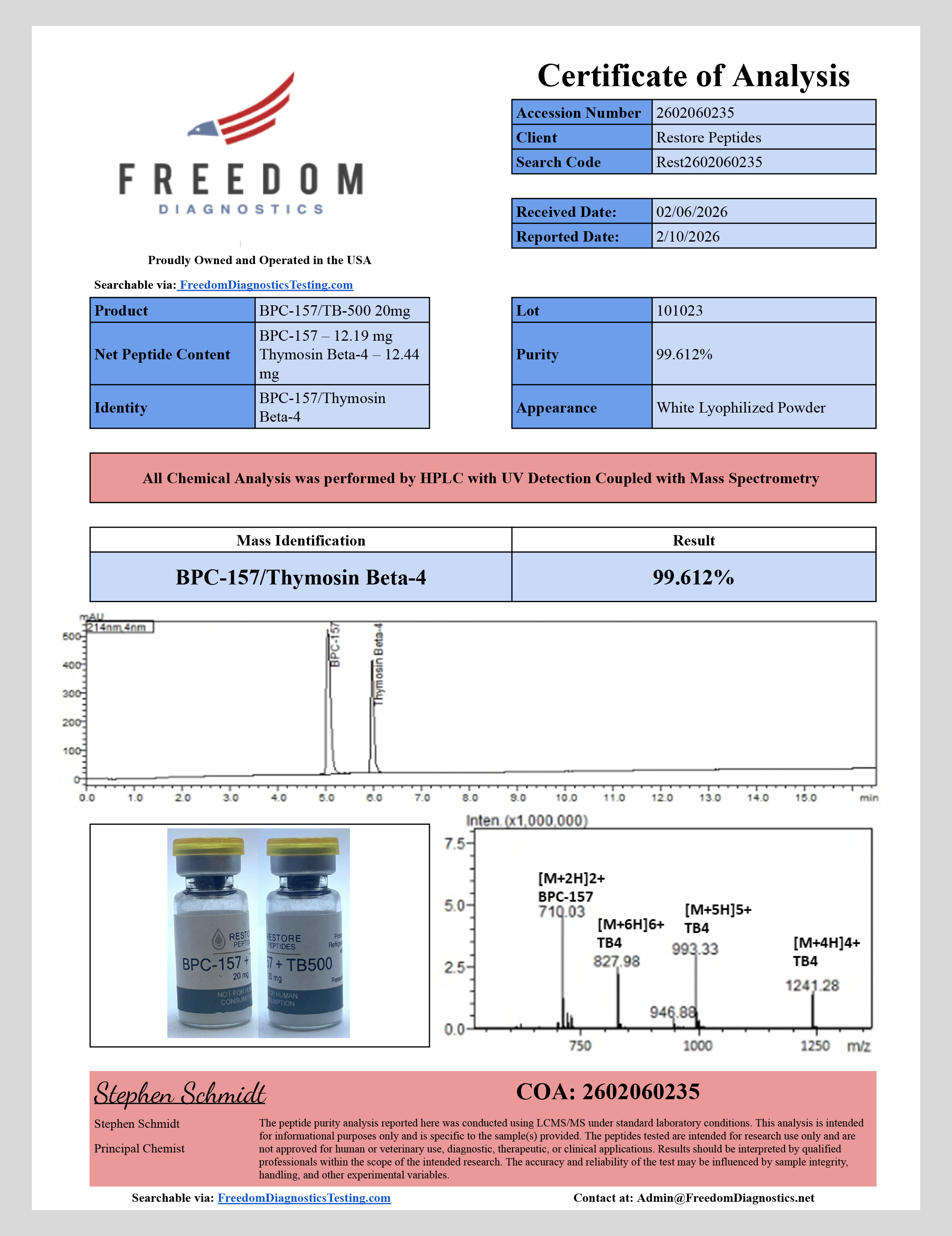
When studying multiple signaling pathways simultaneously, consistency becomes particularly important. Researchers must ensure that the peptide materials used in experiments are well-characterized and verified for identity and purity.
Analytical methods such as high-performance liquid chromatography (HPLC) and mass spectrometry are commonly used to confirm peptide purity and molecular identity before materials are introduced into laboratory models.
Lot-specific documentation also helps researchers maintain reproducibility across experimental trials.
Peptide Stacks as Research Tools
Peptide stacks represent one of many approaches used by researchers to study complex biological systems. By combining signaling molecules that influence different pathways, scientists can observe coordinated biological responses and investigate how these interactions contribute to broader physiological processes.
As peptide science continues to advance, multi-pathway research models will likely remain an important part of exploring how signaling networks regulate cellular behavior.
References
Craik, D. J., Fairlie, D. P., Liras, S., & Price, D. (2013).
The future of peptide-based drugs.
https://doi.org/10.1111/cbdd.12055
Fosgerau, K., & Hoffmann, T. (2015).
Peptide therapeutics: current status and future directions.
https://doi.org/10.1016/j.drudis.2015.01.003
Lau, J. L., & Dunn, M. K. (2018).
Therapeutic peptides: historical perspectives and future directions.
https://doi.org/10.1016/j.bmc.2017.06.052